A recent bottleneck of Y chromosome diversity coincides with a global change in culture
A recent bottleneck of Y chromosome diversity coincides with a global change in culture
Karmin et al. (2015), Genome Research 25(4):459–468
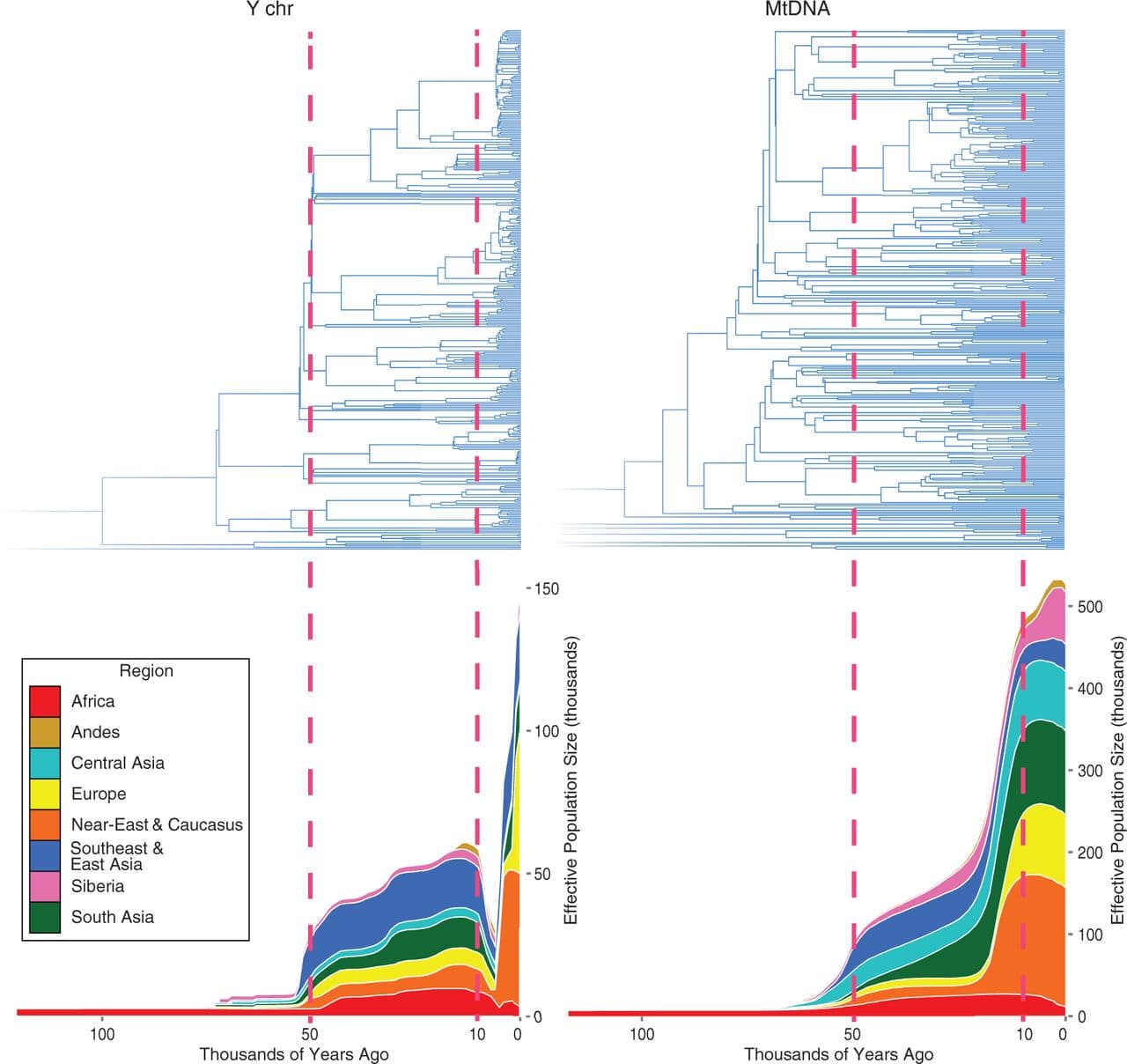
It is commonly thought that human genetic diversity in non-African populations was shaped primarily by an out-of-Africa dispersal 50–100 thousand yr ago (kya). Here, we present a study of 456 geographically diverse high-coverage Y chromosome sequences, including 299 newly reported samples. Applying ancient DNA calibration, we date the Y-chromosomal most recent common ancestor (MRCA) in Africa at 254 (95% CI 192–307) kya and detect a cluster of major non-African founder haplogroups in a narrow time interval at 47–52 kya, consistent with a rapid initial colonization model of Eurasia and Oceania after the out-of-Africa bottleneck. In contrast to demographic reconstructions based on mtDNA, we infer a second strong bottleneck in Y-chromosome lineages dating to the last 10 ky. We hypothesize that this bottleneck is caused by cultural changes affecting variance of reproductive success among males.
The key finding: while mtDNA-based demographic reconstructions show a relatively smooth story, the Y chromosome shows a sharp, recent bottleneck — roughly within the last 10,000 years, and concentrated around 8–4 kya — at which point the female effective population size is up to 17-fold higher than the male. The authors argue this is most likely cultural, not selective: a change in social structures that massively increased the variance in male reproductive success, possibly compounded by male-driven conquest, the spread of Neolithic farming, and innovations in transport (wheel, horse and camel domestication, open-water sailing). They cite the Mongol expansions (Zerjal et al. 2003) as a historical example of the same pattern.
This is one of the central pieces of genetic evidence for the claim that the rise of agriculture, states, and empires produced extreme inequality in male reproductive access — a small number of dominant males leaving enormous Y-chromosomal legacies while the bulk of males left few or none. The well-known modern instance is the Genghis Khan lineage.
Links
- Article: https://genome.cshlp.org/content/25/4/459
- PDF: https://genome.cshlp.org/content/genome/25/4/459.full.pdf
- Figure 2 (large): https://genome.cshlp.org/content/genome/25/4/459/F2.large.jpg
Accessible intro (by some of the same authors)
The Conversation: "There was a decline of male diversity when humans took to agriculture"
When people abandoned a hunter-gatherer lifestyle and became agriculturalists, initially some 10,000 years ago, they gave up a lot of things. This significant shift in the way they obtained their food was probably not something they elected to do. Instead, population pressure and diminishing resources forced people into developing new intensified forms of subsistence.
The study focused on the Y chromosome that is only inherited through the paternal line from fathers to sons. This tells us about origins and migrations of males in the population, but it can also reveal patterns in population changes. These results were compared to those from the mitochondrial DNA, that is the DNA inherited through the maternal line in humans.
This provided a very different picture of the regional male and female effective population size. In general terms, the effective population size is the number of individuals in a population who contribute offspring to the next generation. So the study suggests that there was a global collapse in genetic diversity of the males in contrast to that of females. Essentially this means there was an extreme reduction in the number of males who reproduced, but not a reduction in the number of females.
This appears to correlate with the timing of this major shift in subsistence, referred to by archaeologists as the Neolithic. In fact, Y chromosome genetic data suggests this reduction at around 8,000 to 4,000 years ago. Essentially there was a genetic bottleneck in male genetic diversity at that time which cannot be easily explained through natural selection.
If male reproductive success was being controlled by a smaller number of males of high social order, for example a smaller ruling elite, then we would see a situation where male population (genetic) diversity was reduced. An example of such an event from much later times is Genghis Khan. He was reputed to have sired hundreds of children, resulting in millions of Asian men today who bear a very similar Y chromosome lineage.
The Neolithic introduced a new system of economic production and increased social stratification. The rise of a social elite and followers and the development of hierarchies in a society, independently emerged in several global regions, and later spread across much of the world.
Competition through male-driven conquest represents a signature that archaeologists would find exceedingly difficult to identify from the material archaeological record alone. Studies looking at ancient genomes are starting to detect patterns in population change that would otherwise remain hidden if we relied solely on standard archaeological investigations.