The New Institute Closes its Doors
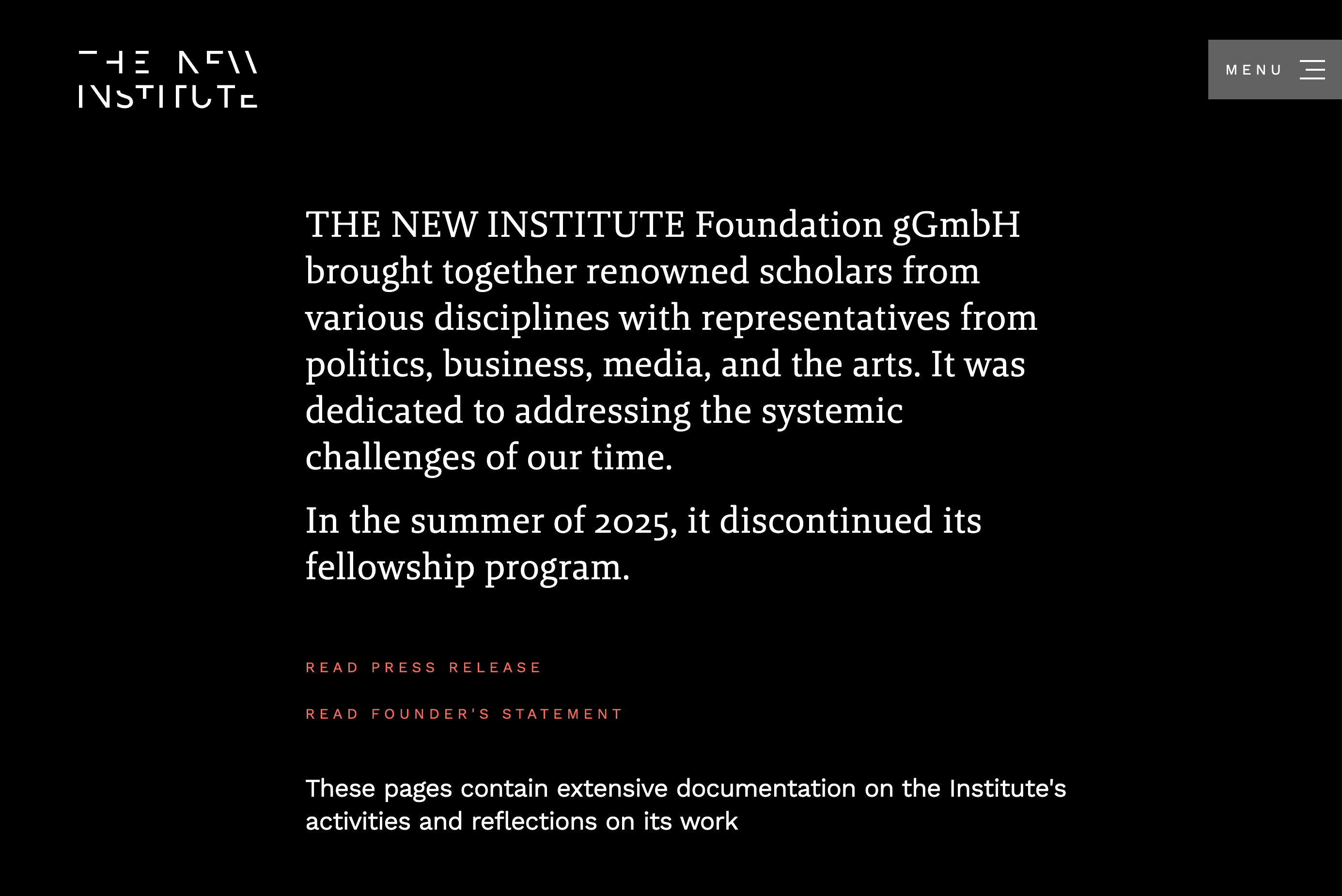
Just came across this fascinating closing statement announcing that the the New Institute closed its doors in March 2026 by its funder and founder Erck Rickmers.1 Rickmers is part of a 150 year old Hamburg shipping dynasty and a SDP politician. The institute was an experimental "Institute of Advanced Study" dedicated to addressing the most important challenges of our times.
I came across New Institute around 2020 and was always intrigued by approach (seemed a bit like Beggruen but more radical) and very impressed by their elegant website (just look at that logo).
The statement is impressive in its forthrightness, as are the other similar reflections e.g. by the MD.
Overall I'm sceptical of (billionaire) philanthrophy, however admirable the aims (though, of course, if you handed me a billion dollars I'd imagine I could do better 😉). In this case, I also feel ten years is not enough to really know the impact. Whatever the case, the assessment is valuable and fascinating.
Some examples of the blunt assessment
Return on resources did not make sense
the resources provided and the societal return did not stand in a reasonable proportion to one another, and the goals we had set for ourselves were only partially achieved. [what goals were achieved?]
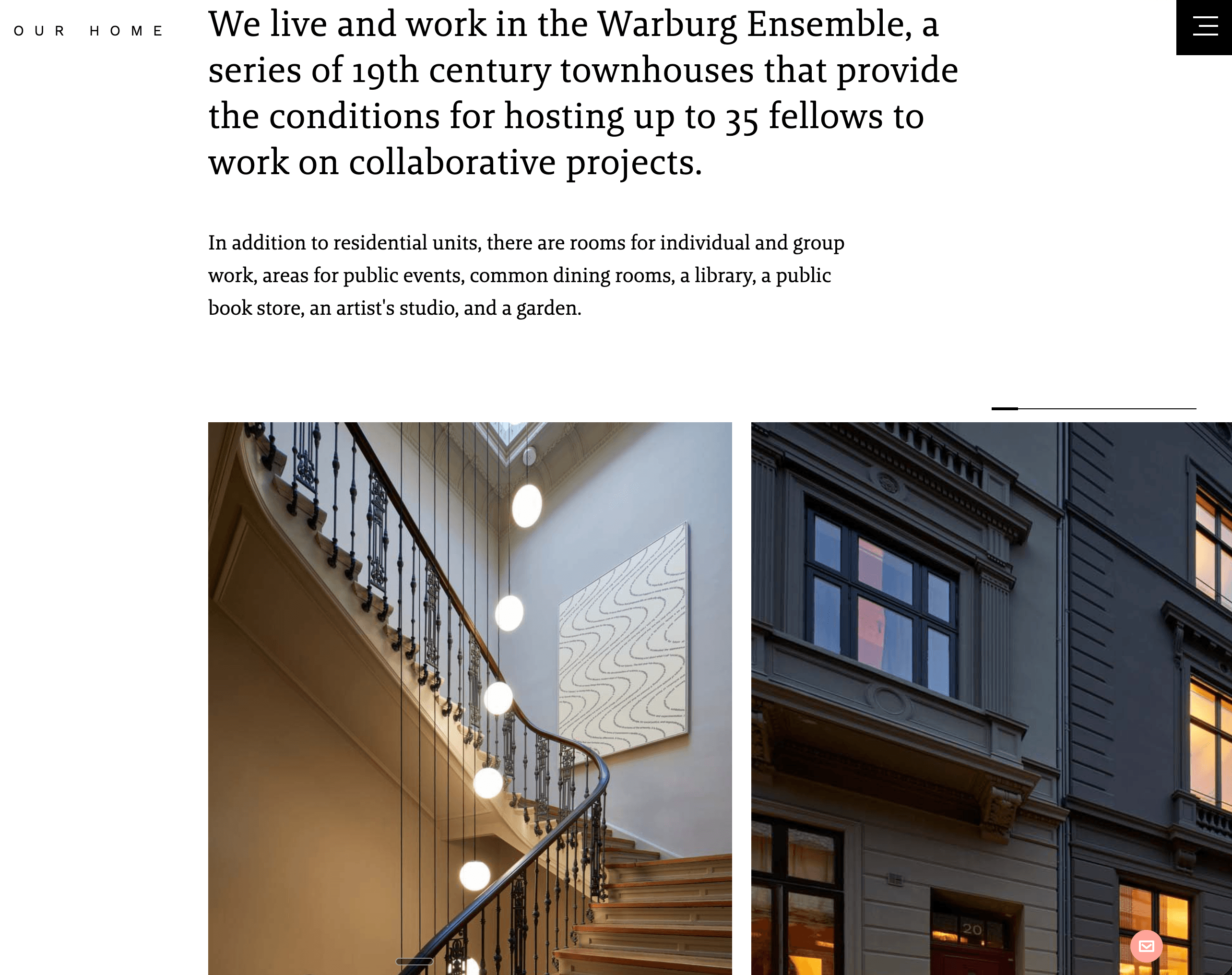
How much resource was provided. I'm guessing €20m plus easily. There's the centres funding, fellowships, a dedicated space in Hamburg renovated by renowned architects plus a beautiful website.
Blunt assessment of academic collaboration
Collaborating with scholars from the humanities and social sciences was sobering at times. For many, considerations of personal career advancement seem to outweigh commitment to a shared purpose.
Given current structure of academia I'm not surprised (though perhaps was always so given the cuthroat nature of the academy). More evidence for Academia is the Catholic Church of Modernity and resembles the Church just before the Reformation.
Ideology and wishful thinking stood in the way of pragmatic approaches
Interdisciplinary collaboration and teamwork proved difficult to organize, and ideology or wishful thinking occasionally stood in the way of pragmatic, reality-based approaches.
This is not a surprise especially if you mainly engage philosophy academics. (not that i don't have a lot of time for philosophy academics)
Some tough feedback
Perhaps this helps explain why disciplines whose perspectives are so urgently needed by society often attract less public attention than one might wish.
Full statement
It's worth quoting in full given its brevity and frankness.
https://thenew.institute/en/media/founder-s-statement
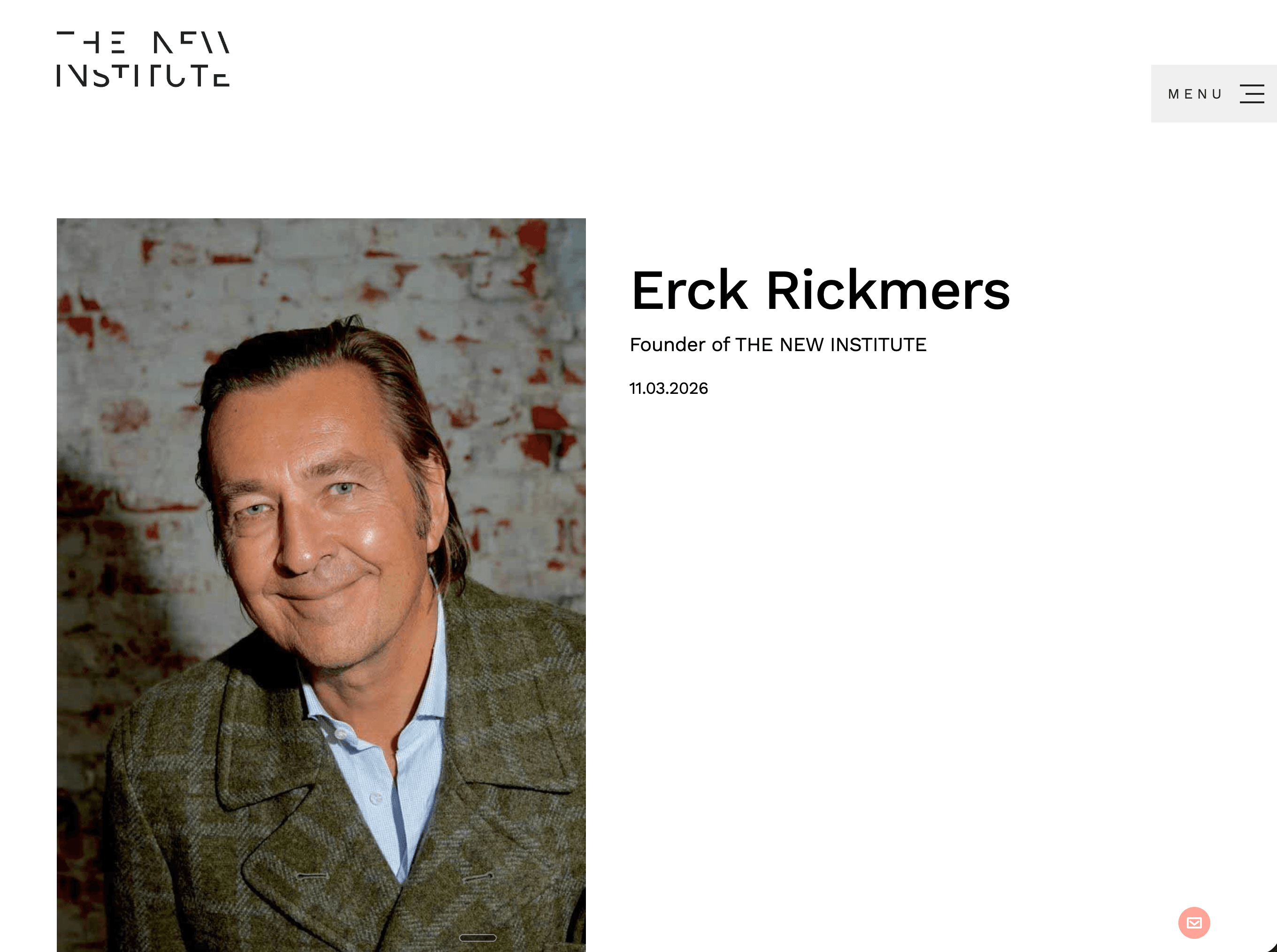
Nearly ten years ago, in March 2016, I established a foundation dedicated to addressing the systemic challenges of our time. The idea was to create spaces where thinkers from the humanities and social sciences could work across disciplines, free from their academic obligations, and develop interventions aimed at advancing societal progress. In an era when ecological and social systems are visibly beginning to collapse, I believed this to be a significant contribution to the public good.
In the early phase, we established four research centres at the University of California, the University of Cambridge, Humboldt University in Berlin, and Ca’ Foscari University of Venice. Beginning in 2021, the foundation operated its own Institute in Hamburg, where around 35 international fellows could live and work.
Much was accomplished during this time. We initiated numerous projects, sparked lively debates, and created a network that has grown over the years and which will continue to have an impact. Several of our fellows and partners made remarkable contributions, whose full significance may only be revealed in the years to come.
At the same time, the resources provided and the societal return did not stand in a reasonable proportion to one another, and the goals we had set for ourselves were only partially achieved. Naturally, an experimental initiative of this kind involved a number of conceptual and personal mistakes, for which, as founder and initiator, I bear full responsibility. Collaborating with scholars from the humanities and social sciences was sobering at times. For many, considerations of personal career advancement seem to outweigh commitment to a shared purpose. Interdisciplinary collaboration and teamwork proved difficult to organize, and ideology or wishful thinking occasionally stood in the way of pragmatic, reality-based approaches. Perhaps this helps explain why disciplines whose perspectives are so urgently needed by society often attract less public attention than one might wish. [emphasis added]
With this report, THE NEW INSTITUTE bids farewell. I would like to express my sincere gratitude to everyone involved for their dedication, idealism, and support. This extraordinary journey is coming to an end, and we hope that others will find ways to create formats capable of constructively advancing the societal transformation that is so urgently needed.
Erck Rickmers
February, 2026
Miscellaneous other reflections
The repetition of patterns we seek to transform
From Minna Salami. Boy do i empathise … i think we all end up repeating (some) of the patterns we are seeking to transform
https://thenew.institute/en/reflections/minna-salami
At the same time, it was a year of turbulence for the institute. As a collective, we were in disequilibrium: ambitious and experimental yet unsettled. Conflicts flared between differing visions, egos, and expectations. It was painful to witness the repetition of the very patterns we sought to transform––essentially problems of difference.
Footnotes
-
The Institute was winding down from August 2024 according to this PR https://thenew.institute/en/media/the-new-institute-discontinues-its-fellowship-program-in-2025 ↩